Everything Miwa does for you
Miwa is the operating software for mental health private practice: scheduling, client billing, a real-time insurance-claims stack, a finance command center, telehealth, and documentation, with built-in automation that handles the busywork. Real app surfaces, shown feature by feature. Every draft is yours to review. Miwa doesn't practice therapy. You do.
Practice management software. The operating software for your practice.
Miwa runs the business of your practice: scheduling, a real-time insurance-claims stack (eligibility, COB, 837, ERA, denial resolution), client billing, a finance command center, telehealth, workflows, and supervision and exam prep, with charts and documentation built in.
Practice operations
Scheduling, telehealth, client billing, real-time insurance claims, superbills, and finances.
Clinical records
Charts, notes, treatment plans, assessments, crisis tools, and e-sign, built into the same system that runs your business.
Built-in automation
Miwa drafts, schedules, sends reminders, answers the front desk, and runs workflows. You review before anything goes out.
Full lifecycle
Trainee hours, supervision, and exam prep, an associate scribe and telehealth, to a licensed private-practice command center.
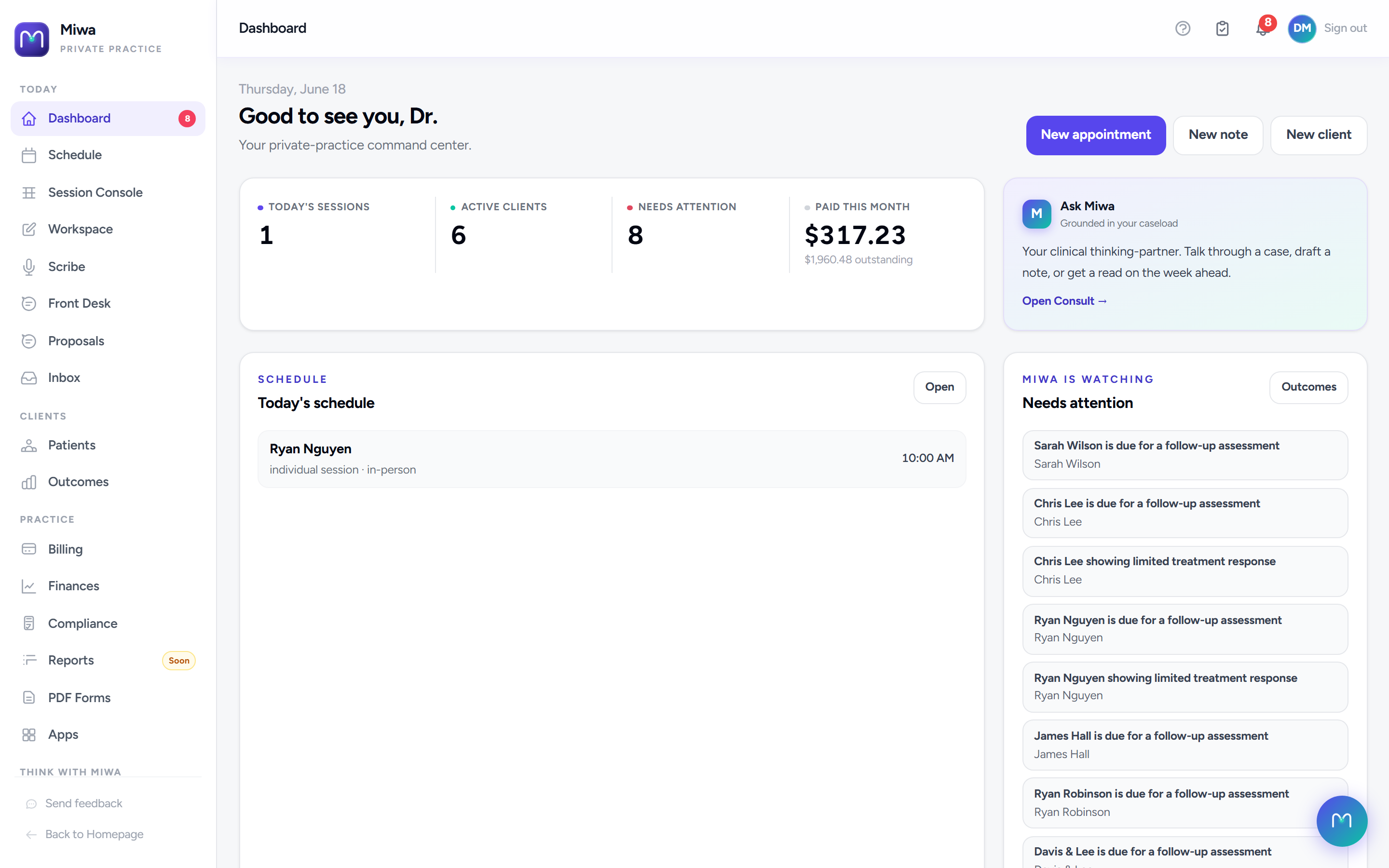
Practice Command Center
Licensed clinicians run their whole solo practice from one screen: today's schedule, what needs attention, this month's revenue, and caseload health at a glance.
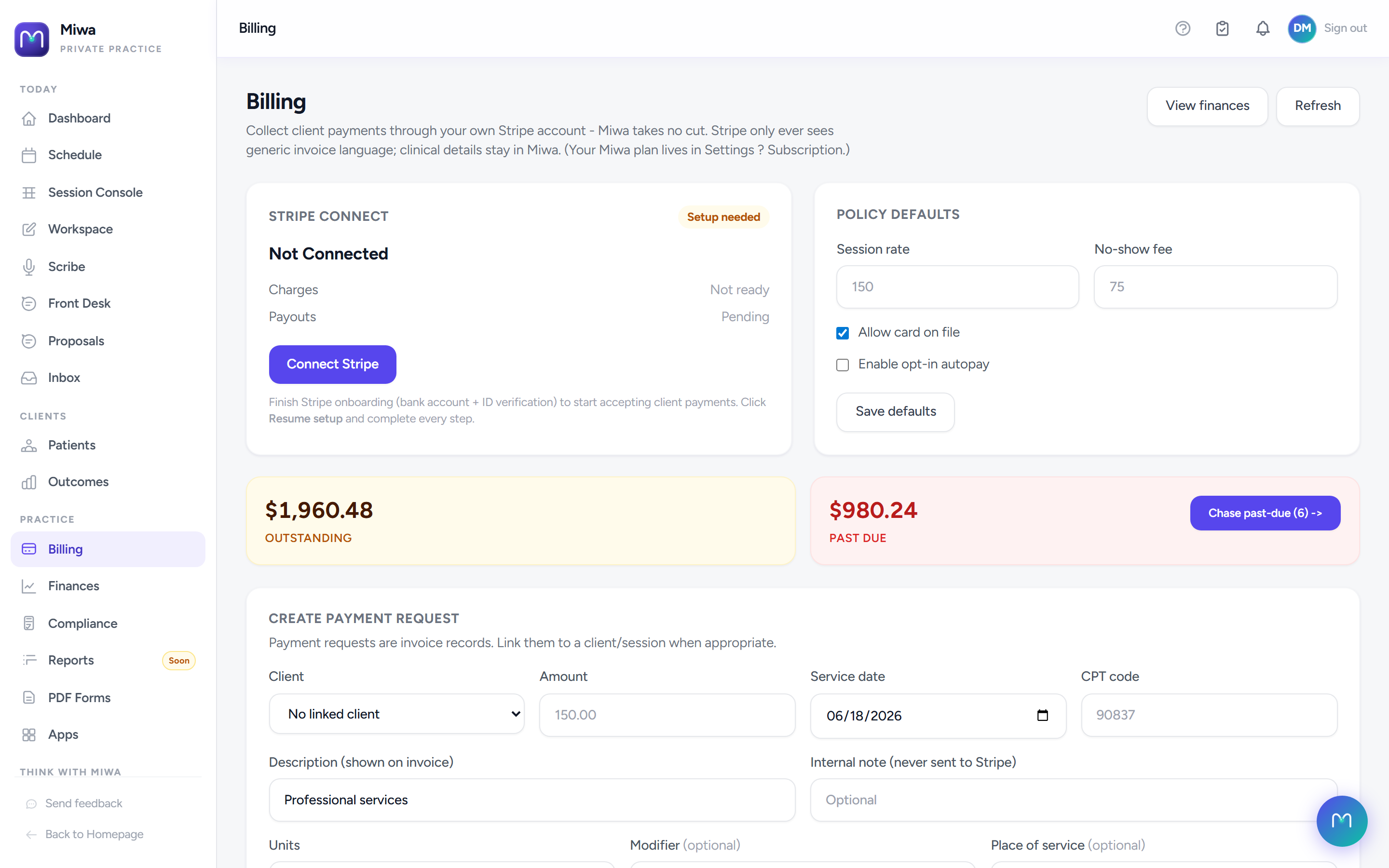
Client Billing
Collect private-pay invoices through your own Stripe account, no platform fee. Create an invoice from a chart, charge a card on file, and let clients pay from their portal.
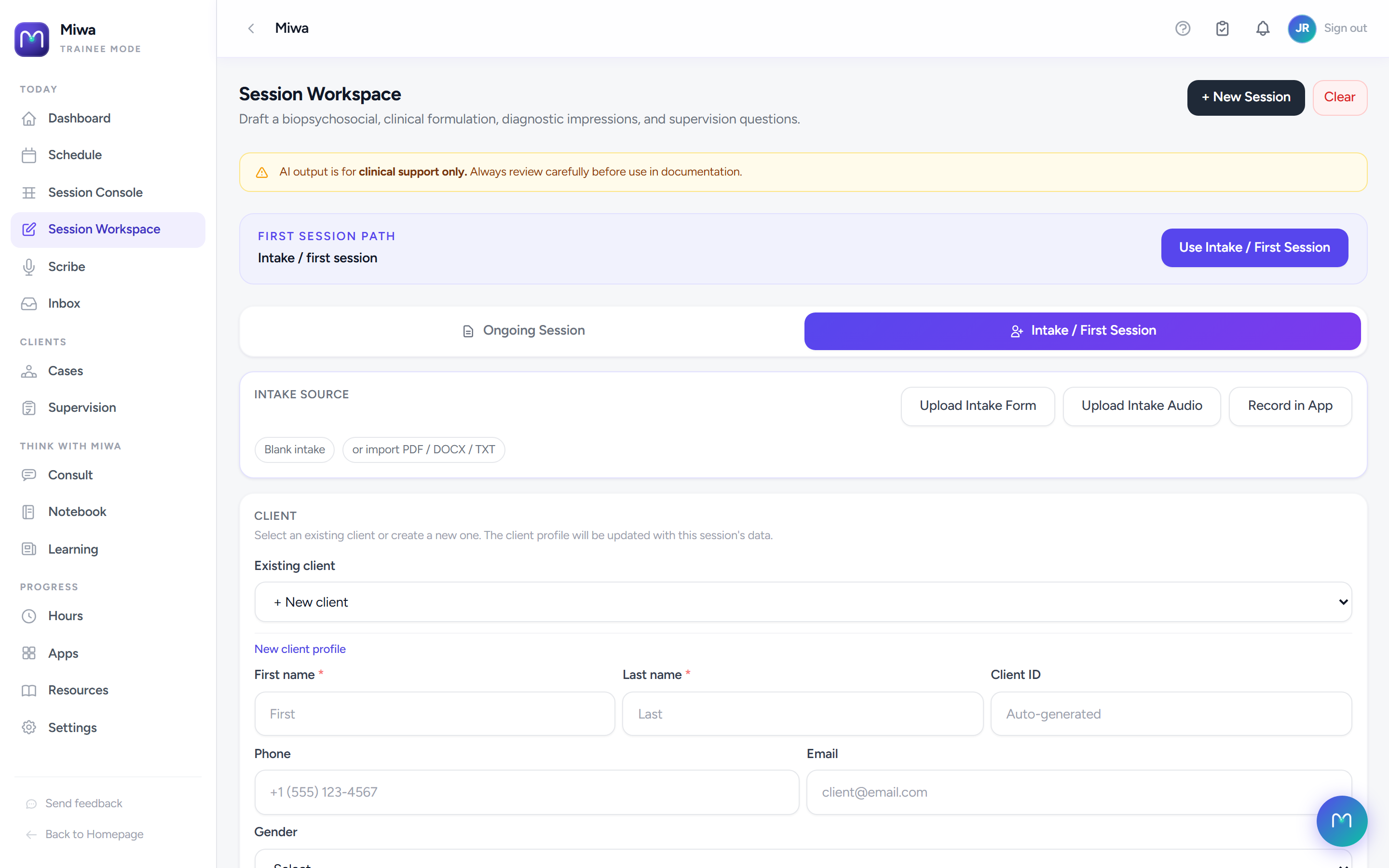
AI Progress Notes
Dictate a 3-minute session recap. Miwa generates SOAP, BIRP, DAP, and GIRP notes simultaneously, ready to sign.
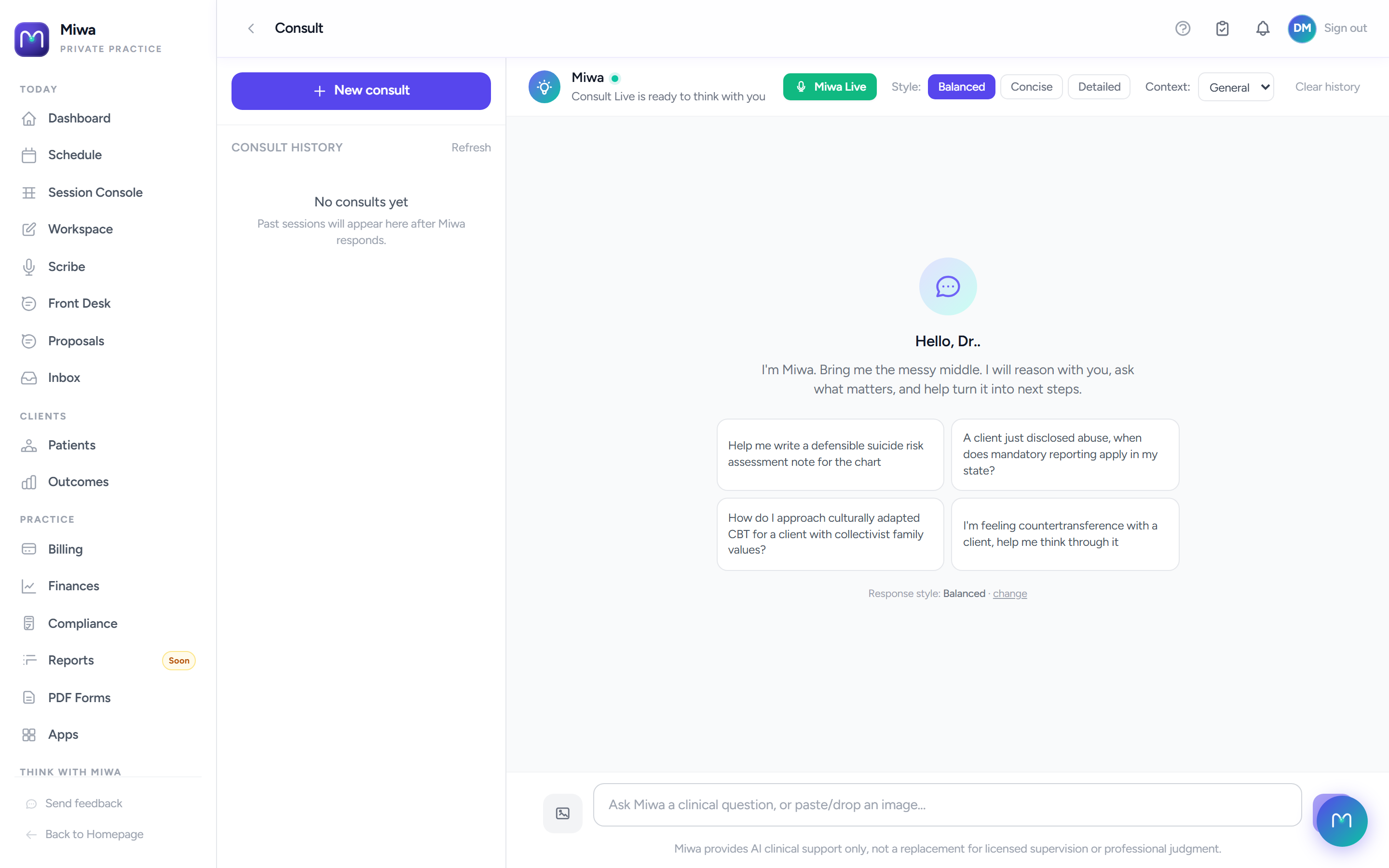
Built-in automation
Tell Miwa what needs doing in plain language and it handles the busywork: scheduling, assessments, reports, calls, and workflows, with 30+ built-in actions you review before anything goes out.
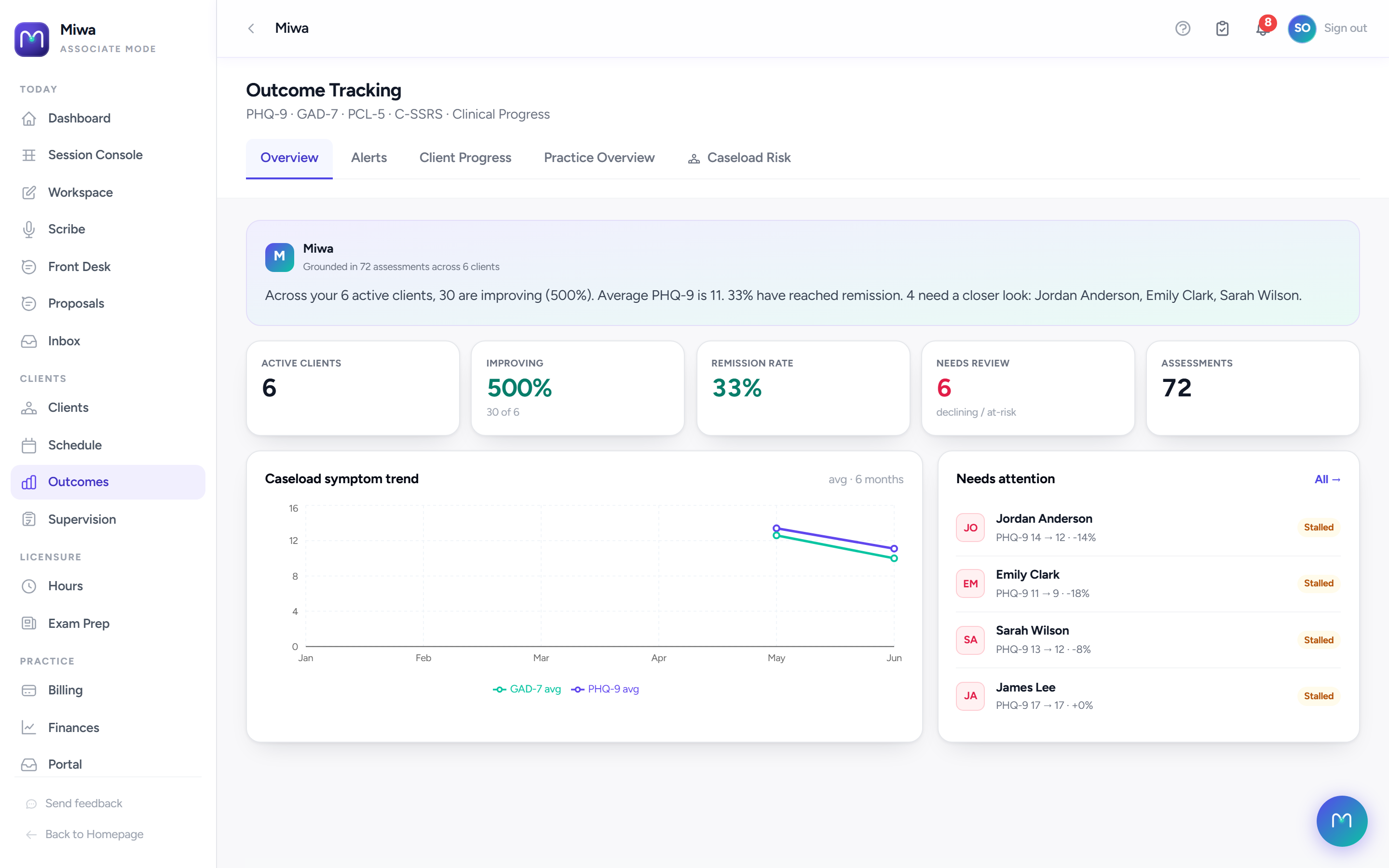
Outcome Tracking
PHQ-9, GAD-7, PCL-5, and C-SSRS shared through secure links. Clients complete them on mobile, and scores appear with trend tracking.
Pre-Session Briefs
A 60-second narrative ready 30 min before every session: where you left off, mid-week check-ins, assessment shifts, and two threads worth picking up.
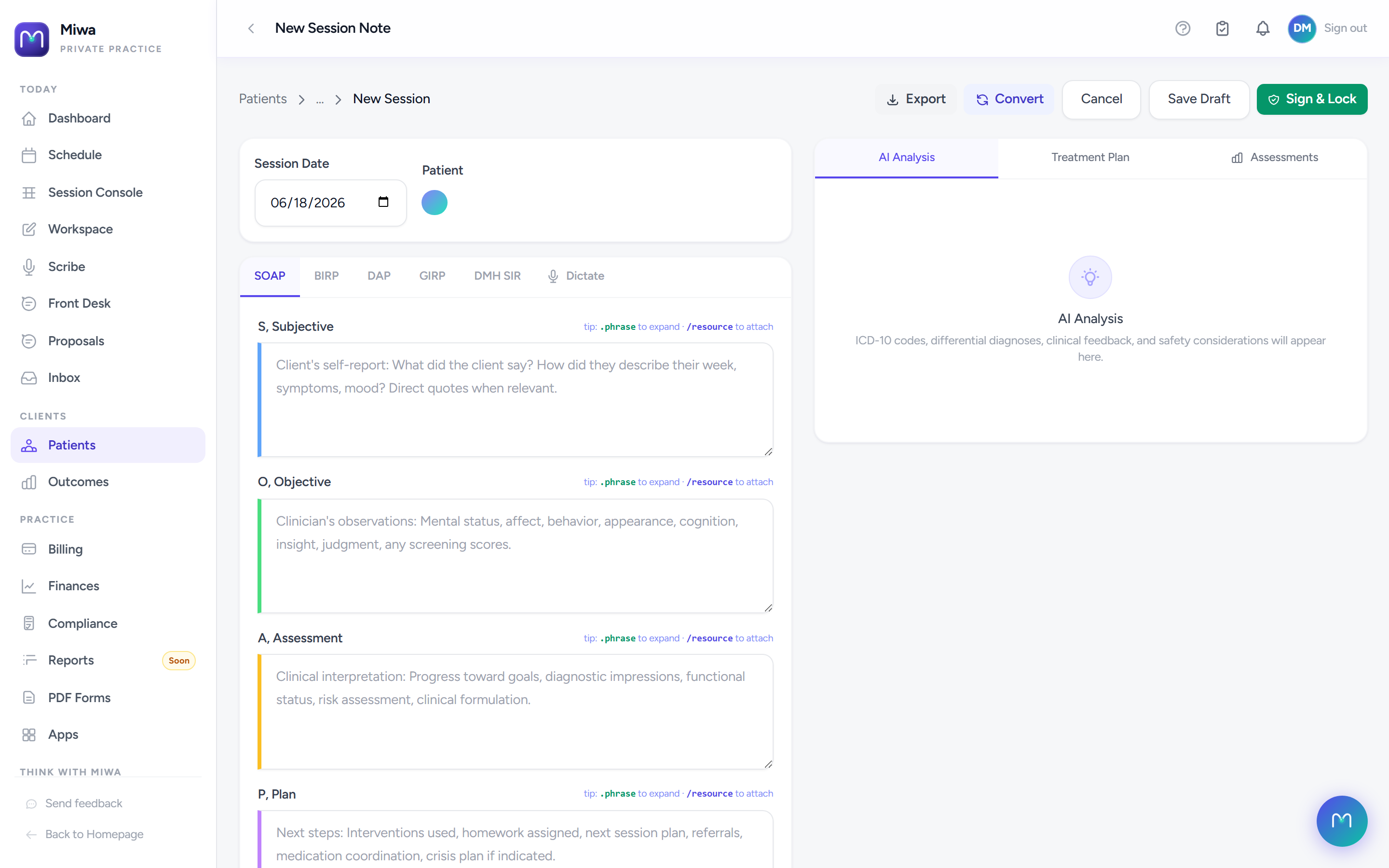
Active Risk Monitor
As you type session notes, Miwa watches for risk language (SI, HI, self-harm, abuse) and nudges you toward the right screening tool if it's not already on file.
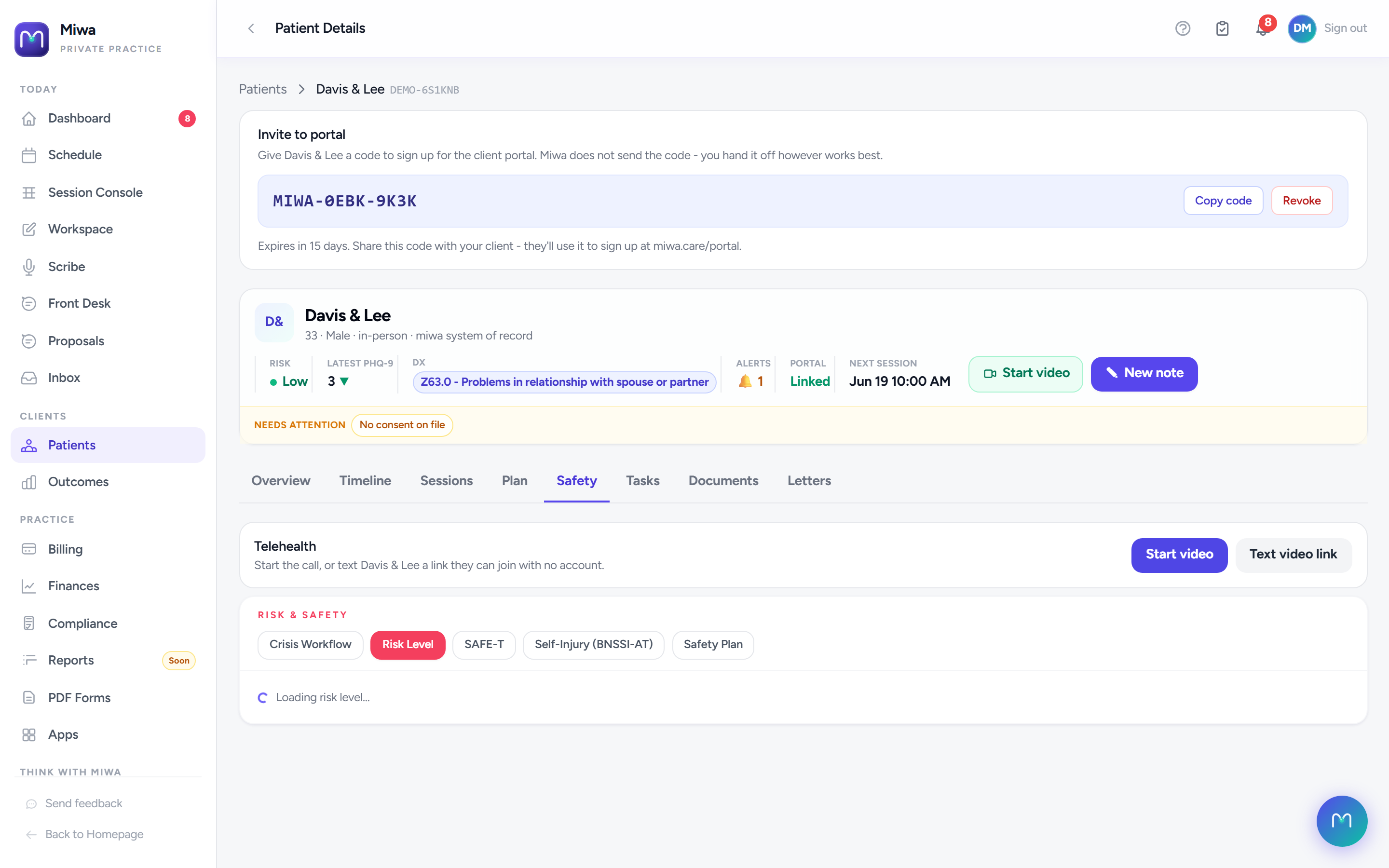
Crisis & Safety Suite
When risk shows up, the tools are already there: a bilingual Safety Plan, Risk Level triage, the Columbia SAFE-T assessment, and an NSSI self-injury screen, built into the chart, not bolted on.
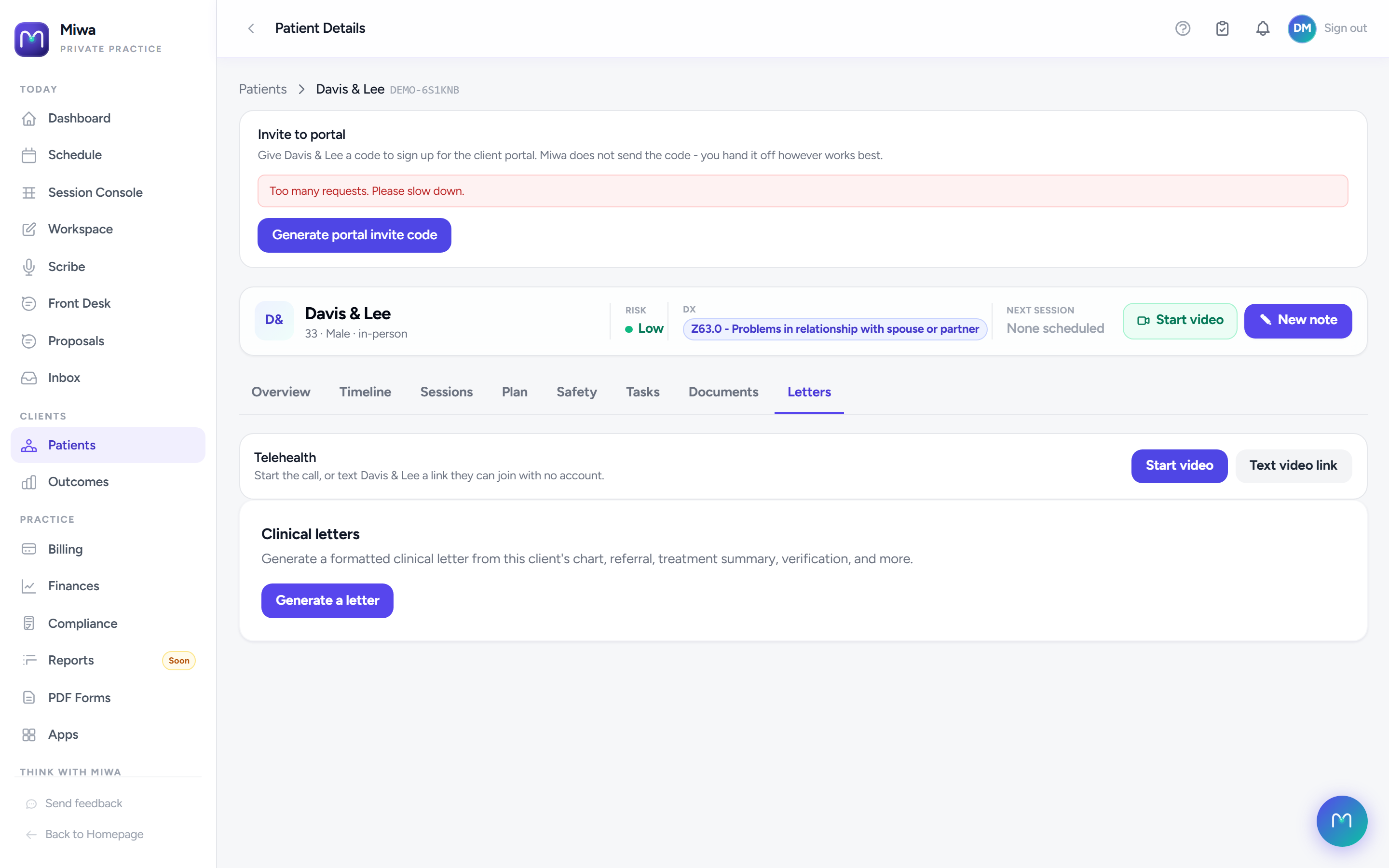
Letter Generator
ESA letters, school 504 support, insurance pre-auth, attorney summaries, return-to-work, drafted from the chart in your voice. Review, edit, sign.
Morning Briefing
A dashboard briefing for the start of the day: who needs attention, who's improving, who's overdue, and what to prep first.
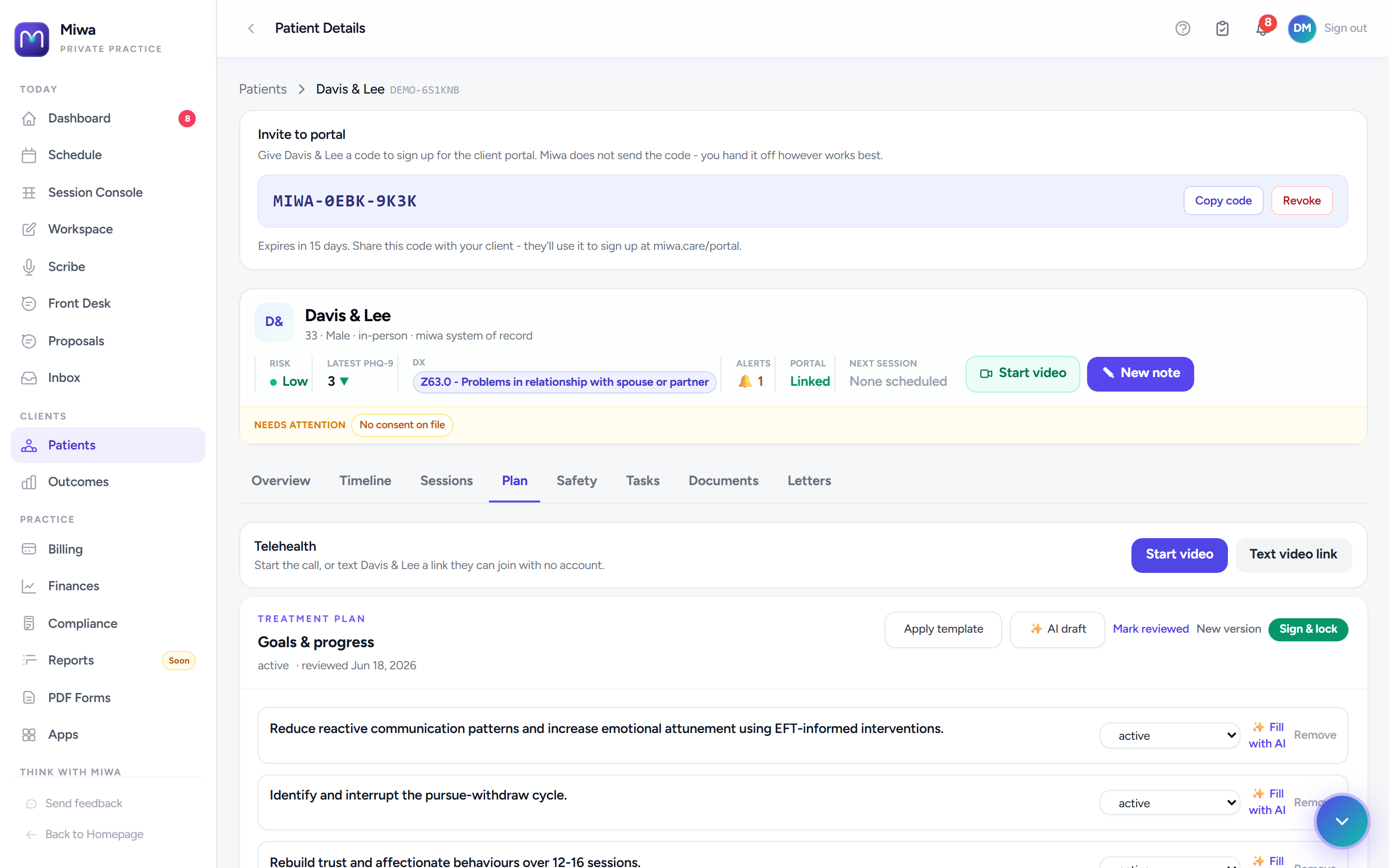
Treatment Plan Agent
Living treatment plans that update as sessions progress. Goals, objectives, and interventions stay current automatically.
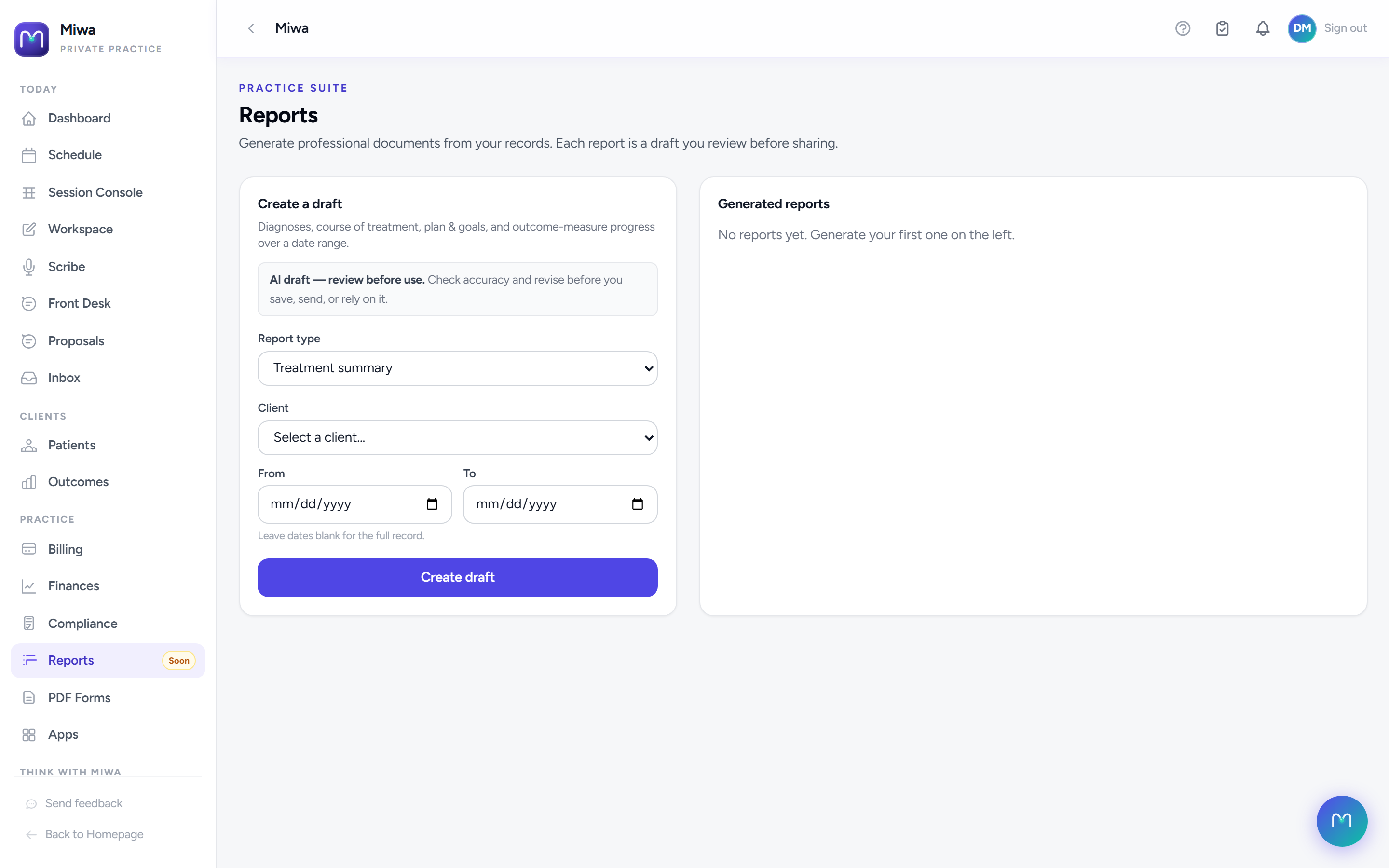
Reports
Generate court reports, insurance summaries, and supervision documentation from session data in seconds.
Every tool, in detail
Feature availability follows account stage and credential verification.
Client Billing & Real-Time Insurance Claims
Your Stripe, no platform fee
Collect private-pay invoices through your own Stripe Connect account. Miwa never takes a cut of what you bill, your subscription is the only cost.
Invoice from the chart
Create an invoice straight from a client's chart at their default session rate, then send it or charge a card on file.
Clients pay from their portal
Clients see and pay their own invoices from the client portal. Past-due invoices surface on your dashboard automatically.
Void & refund
Full invoice lifecycle, draft, send, pay, void, and refund, reconciled through hardened Stripe webhooks. Licensed billing only.
Telehealth
Encrypted peer-to-peer video
Calls run directly between you and your client (DTLS-SRTP encrypted). No extra vendor, no per-minute fees.
Group sessions & guest links
Host couple, family, or group calls, and text a one-tap SMS join link to clients who don't have a portal account.
A call screen built for therapy
Pre-call device check, virtual backgrounds and blur, screen share, and in-call session notes so documentation starts during the session.
From the chart or the schedule
Start a session from a patient chart or calendar appointment. Telehealth appointments auto-derive the right CPT modifiers on superbills.
Practice Growth
Public booking page
An opt-in public profile with a shareable booking page for your own practice. New-client requests land in Settings, ready to triage.
Intake forms & e-signature
Build or use templates (new-client intake, informed consent, ROI). Clients complete and e-sign in the portal; you get a branded PDF.
Payment plans
Split a balance into 2 to 36 monthly installments, each a normal invoice on its own schedule.
Insurance eligibility & claims-ready
Real-time 270/271 eligibility checks through your own clearinghouse account, with 837P claim submission and pre-submit validation built in and rolling out.
Practice Intelligence & Reports
Cross-client pattern discovery
Miwa identifies patterns across your caseload: common stressors, treatment response trends, and cohort insights.
Court & legal reports
Professional progress reports formatted for court, attorneys, or probation officers, generated in seconds.
Supervision reports
Structured supervision notes, case conceptualizations, and training documentation.
Per-client supervision prep & action items
Work your caseload client by client: queue prep questions to bring up, capture what your supervisor said, and turn it into checkable action items.
Research briefs
Weekly peer-reviewed research synthesis tailored to your caseload specialties.
Client portal invite codes
Generate single-use portal codes from a patient chart. Clients redeem the code to access their portal, complete assessments, and view shared materials.
Clinical Documentation
Voice dictation to notes
Record a 3-minute session recap. Receive a formatted SOAP, BIRP, or DAP note in seconds.
Note enrichment
ICD-10 code suggestions, risk flags, and continuity threading added automatically to every note.
Multi-format output
SOAP, BIRP, DAP, and GIRP generated simultaneously from a single dictation (plus LA County DMH SIR). Switch formats instantly.
Documentation backlog center
See every unsigned note across the caseload, open the ones that need edits, and bulk-sign the notes that are ready.
Session attendance tracking
Check-in, late arrival, no-show, and cancellation tracking for every session.
Built-in automation
30+ function-calling tools
Miwa does more than chat. It drafts, schedules, sends, calls, and runs multi-step workflows across the practice, review-before-apply.
Plain-language interface
Talk to Miwa like a colleague. It understands clinical language, reads context, and handles multi-step work, not just answers.
Multi-step task execution
Miwa helps with longer tasks like client onboarding, case closure, and court prep through plain conversation.
Full caseload context
Every Miwa session starts with your entire caseload: scores, trends, risk flags, and treatment progress.
Learns your voice
Every time you edit an AI draft, Miwa learns your style. After ~10 sessions, the first draft already sounds like you wrote it.
Miwa Live (realtime voice)
Talk to Miwa out loud, hands-free, in a live voice conversation, not just dictation. Useful between sessions or on the go.
Built for your discipline
Miwa tailors its clinical lens, ethics codes, exam framing, and terminology to your field: MFT, social work, counseling, or psychology.
Active Risk Monitor
Real-time language scanning
Miwa watches your session notes for SI, HI, self-harm, and abuse disclosure language as you type, non-blocking, never in your way.
Screener-coverage check
If the risk matches a screener (C-SSRS, Tarasoff) you haven't administered recently, Miwa nudges you to consider one.
Knows denial from disclosure
It can tell "client denied SI" from "client endorses passive SI", no nagging on routine clearance language.
Ethical escalation scanner
Notes containing SI, HI, abuse disclosures, or Tarasoff-relevant language trigger a specific flag in the risk/safety check step.
Letter & Form Generator
Five clinical templates
ESA letters, school 504 support, insurance pre-authorization, attorney summaries, return-to-work / fitness-for-duty.
Drafted from the chart
Miwa pulls diagnosis, treatment course, assessment scores, and functional observations. You pick the template; Miwa writes the first draft.
In your clinical voice
Uses your letterhead, credentials, and (once learned) your writing style. Never invents facts that aren't in the chart.
Review, edit, finalize
Every letter is a draft. You edit inline, save, finalize, copy, or download, sign before sending.
Morning Briefing
Morning dashboard brief
The single thing every clinician opens to start the day: caseload pulse, prep priorities, and recent changes.
Per-client status
Every active client labeled: stable, improving, needs attention, overdue, or new referral, sorted by clinical urgency, not schedule order.
Suggested prep order
Miwa recommends which client to prep first if you only have 20 minutes before your first session.
Overnight assessment completions
Any scores that came in overnight are surfaced with trend context, improving or concerning.
Pre-Session Briefs
Auto-generated before appointments
Miwa prepares a clinical brief 30 minutes before each session, last session summary, score trends, and open goals.
Treatment continuity
Never start a session cold. See what was discussed, what homework was assigned, and what to follow up on.
Risk and alert summary
Any deterioration flags, overdue assessments, or safety concerns are highlighted at the top of the brief.
Goal tracking context
Active treatment plan goals and progress are surfaced so you can check in on what matters.
Treatment Plan Agent
Living treatment plans
Treatment plans that update automatically as sessions progress, goals, objectives, and interventions stay current.
Auto-progress tracking
Miwa tracks goal progress across sessions and flags when objectives are met or stalled.
Measurable outcomes
Assessment scores are linked directly to treatment goals, so progress is data-driven.
Plan generation
Generate treatment plans from intake data, or let Miwa evolve them from session notes over time.
Proactive Alerts & Outreach
Deterioration detection
Miwa monitors score trajectories and alerts you when a client is worsening, before the next session.
Risk review flags
Safety concerns from session notes and assessment scores are surfaced proactively for clinical review.
Drafted outreach
Miwa can help prepare appointment reminders, missed-session follow-ups, and mood check-ins for clinician review.
Overdue assessment alerts
Miwa tracks assessment cadences and flags when clients are overdue for PHQ-9, GAD-7, or PCL-5.
Assessment Delivery
A growing instrument library
PHQ-9, GAD-7, PCL-5, C-SSRS, ASRS (ADHD), AUDIT, DAS-4, SCORE-15, FAD, RAS, self-care, and an NSSI self-injury screen, shared as secure links.
Live scoring + source citations
Scores compute live as the client answers, with severity from published cutoffs and a citation to each instrument's source.
Batch assessment sender
Send assessments to your entire caseload or filtered subsets at once, including only clients who are missing a recent score.
Trend tracking & cadences
Score history shows trajectory at a glance, and recurring per-client schedules let Miwa handle delivery, reminders, and follow-up.
Crisis & Safety Suite
Bilingual Safety Plan
Build a collaborative safety plan with the client, warning signs, coping, supports, crisis contacts, and means restriction, in English or Spanish.
Risk Level triage
A structured risk-level workflow helps you document and act on acute vs. chronic risk consistently.
Columbia SAFE-T
The full Columbia SAFE-T comprehensive suicide assessment, built into the chart and auto-surfaced when risk language appears.
NSSI self-injury screen
A dedicated non-suicidal self-injury (BNSSI-AT) screen with severity characterization, separate from suicidal-ideation tooling.
Clinical Tools & Apps
Genogram builder
Map family structure and relational patterns, standalone or linked to a chart, and export to PDF, PNG, or SVG.
Ecomap builder
Diagram a client's social ecosystem and supports, with the same export options.
Diarized relational sessions
Couple, family, and group audio is transcribed with speaker diarization so each voice is attributed (you confirm the labels).
Client portal
Clients get a secure portal for messages, assessments, homework, documents, appointments, and billing, invited with a single-use MIWA code.
Documents In
Paste-to-chart
Paste a blob from your site EHR. Choose exact or scrubbed: PHI is de-identified in your browser before anything is sent. Review, then build the chart.
Batch document import
Drop up to 20 PDFs, photos, and forms; Miwa extracts each one (including scanned documents via OCR) and assembles a single reviewable chart.
Assessments import as data
Scores found in documents (PHQ-9, GAD-7, and more) become real structured assessments on the chart, not just pasted text.
Enrich an existing chart
Importing into a client you already have shows a per-field merge preview. Nothing is overwritten without your say-so.
Mobile & Languages
Native iOS & Android apps (beta)
Push notifications for high-priority alerts, offline capture for notes and hours, and haptics where they matter.
Voice quick capture
Tell Miwa something to do from anywhere in the app: one tap, speak, review, done.
Post-session voice debrief
Talk for a minute after a session; Miwa drafts the note, homework, and follow-up task from what you said.
Four languages
The app and client portal run in English, Spanish, French, and Chinese, switchable in Settings.
See it on your own caseload.
Run your whole practice from one place.
Solo Private Practice $199/mo · Group practices from $199/mo
Are you a client? Access your portal